
HireVue vs Arctic Shores vs pymetrics vs Cappfinity: how the assessments differ
HireVue vs Arctic Shores vs pymetrics vs Cappfinity: how the assessments differ
Last checked: 26 November 2026 · 12 min read
How we compare. This article explains what each vendor actually asks candidates to do, how long it takes, and how the result is scored. Where the vendor publishes the detail, we use the vendor. Where it does not, we say the detail comes from prep guides or candidate reports, and we treat it as reported, not confirmed. No vendor pays for placement here, and no assessment in this article has an answer key to memorise.
Why this comparison exists
Four names cover most game-based and strengths-based screening in graduate hiring, and candidates meet them in the same week, often for the same employers. They look similar from the invitation email, a link, a deadline, a browser window, but they measure different things in different ways. HireVue scores how you play short adaptive games. Arctic Shores watches how you behave across tasks and compares that with a job-fit profile. pymetrics builds a trait profile and matches it against people already doing the job. Cappfinity is not a game battery at all: it is a strengths assessment built from workplace scenarios, reasoning tests and video answers. SHL, covered briefly at the end, is the older question-based suite many of these vendors are compared against.
Knowing which one you face changes what to practise. Timed reasoning drills help for HireVue and SHL. They do almost nothing for the behavioural half of Arctic Shores or pymetrics, where there is no right answer to drill. And Cappfinity rewards reading the invitation carefully, because the employer chooses your exact mix of modules.
The comparison at a glance
| HireVue | Arctic Shores | pymetrics (Harver) | Cappfinity | |
|---|---|---|---|---|
| What it is | Game-based assessment, often paired with video interview questions | Task-based psychometric assessment | Neuroscience-based games, now Harver's game-based platform | Strengths-based assessment: scenarios, reasoning, video |
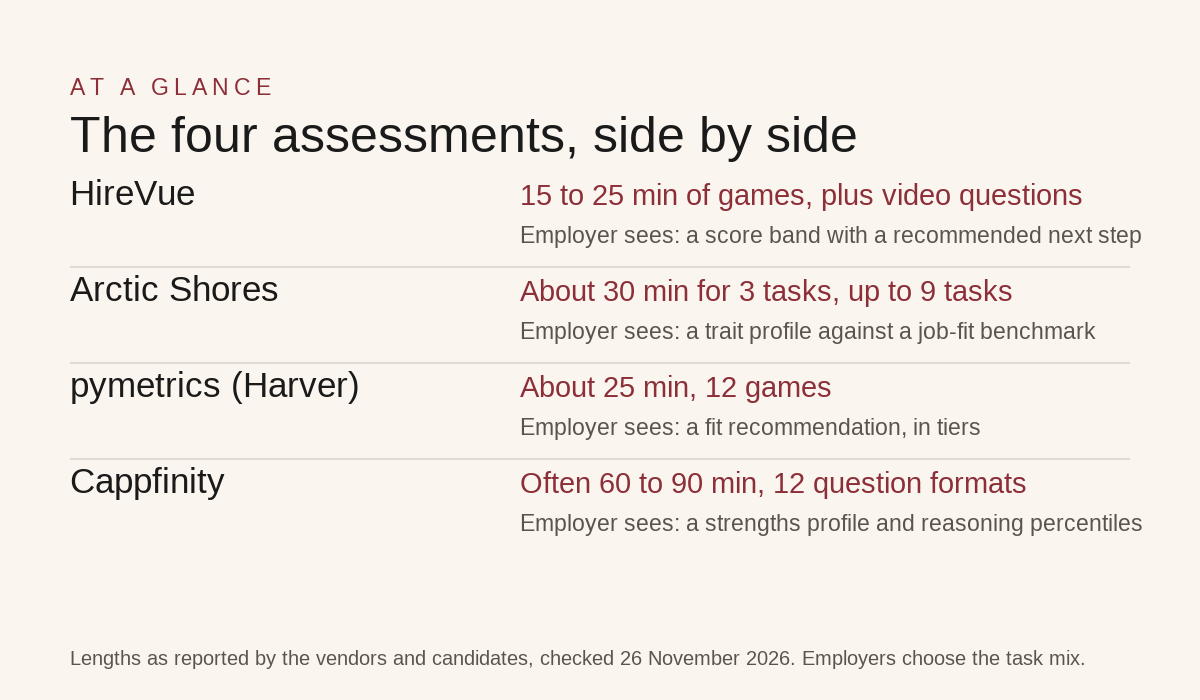
| Typical length | 15 to 25 minutes for games plus video questions; each game about 3 minutes | About 30 minutes for 3 tasks; up to about an hour for 8 or 9 tasks, per candidate reports | About 25 minutes; 12 games at 2 to 3 minutes each | Varies by employer; commonly reported examples run about 60 to 90 minutes |
| Number of tasks | Employer chooses, typically 2 to 3 games plus 3 to 6 video questions | Employer chooses, up to 9 tasks | 12 games in the standard set; some employers use a subset | Employer chooses from 12 question formats |
| Timed? | Yes, each game on its own clock | Largely untimed overall; individual tasks have their own limits | Yes, each game timed, with pauses allowed between games | Behavioural questions mostly untimed but time recorded; some cognitive sections timed |
| What is scored | Cognitive ability and personality traits, from play data | Personality and Workplace Intelligence, from behaviour across tasks | 9 trait categories, from play patterns | Capability and motivation together, against an employer success profile |
| Result the employer sees | A score band, with a recommended next step | A trait profile against a job-fit benchmark, not a mark out of 100 | A fit recommendation, reported as tiers such as Recommend or Highly Recommend | A strengths profile and reasoning percentiles against the employer's norm group |
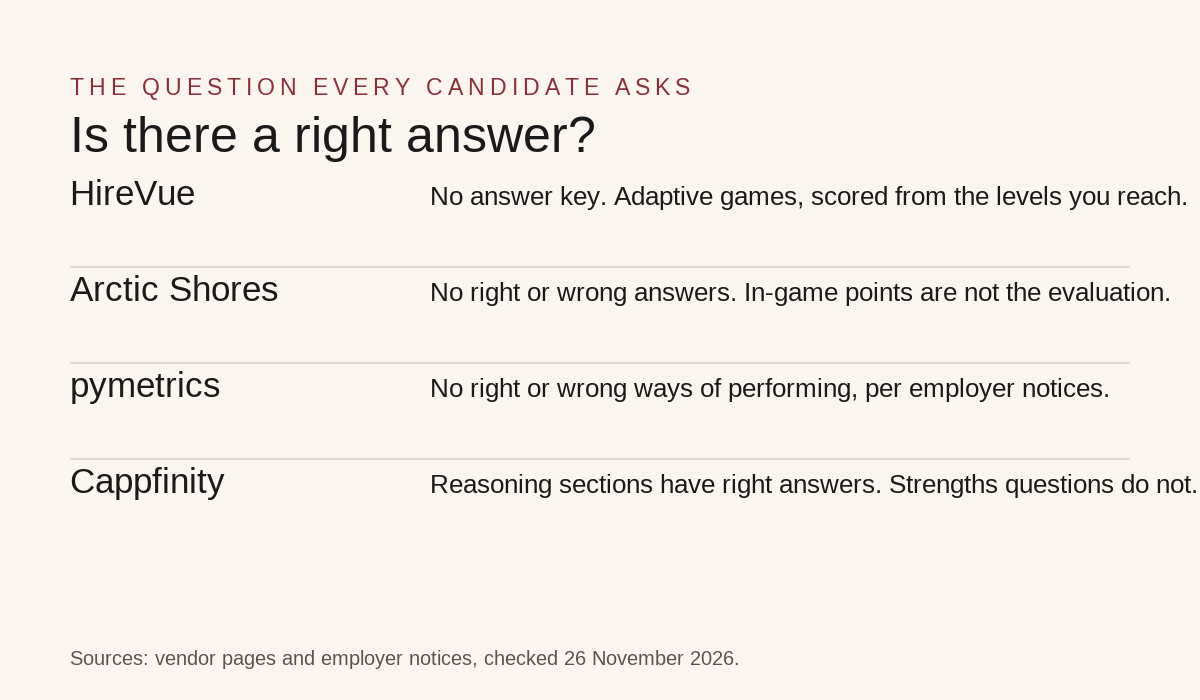
| Right answers? | No answer key; games are adaptive and scored from levels reached | Officially no right or wrong answers; in-game points are not the evaluation | No right or wrong ways of performing, per employer notices | Reasoning sections have right answers; strengths questions do not |
| Who uses it | Graduate employers across banking, consulting, retail and more, including Deloitte and others named in employer pages | Siemens, Capita, Thales, Molson Coors and 350 plus organisations, per the vendor | BCG in some offices, JPMorgan, Accenture, EY, PwC, Blackstone, Unilever, per prep guides | HSBC, EY, Deloitte and other graduate employers, per prep guides and employer pages |
Figures are as reported on 26 November 2026. Every employer configures its own version, so your invitation and instruction screens outrank any table, including this one.
HireVue: short adaptive games, scored by a model
HireVue's game-based assessment is a set of short interactive tasks played in a browser or in the HireVue app. Each game takes about 3 minutes, starts with easy levels so you can learn it, and gets harder as you succeed. HireVue's own guidance puts a typical sitting at 2 to 3 games plus 4 to 6 video questions, 15 to 25 minutes in total, and suggests setting aside about 30 minutes. Prep sites report the common invitation as 4 to 6 games, so treat the count as employer-chosen, not fixed.
The games fall into two families, in HireVue's own description. Cognitive games measure abilities such as numeracy, working memory, problem solving, attention and pattern recognition. Behavioural games measure personality traits such as conscientiousness, and some tasks ask you to read social cues. HireVue publishes game types, not an official list of game names. The names candidates report, Numerosity, Flashback, Pathfinder, Digitspan, Shapedance, Singularity, PortraitXT, E-Motions and others, come from prep sites and candidate reports. Treat them as reports, not a guaranteed line-up: the instruction screen before each game is the reliable guide.
Scoring is where HireVue is most transparent, and also most misunderstood. According to HireVue's 2025 AI Explainability Statement, the scoring model takes your game data, including the ratio of levels won to levels lost, how many levels you played, the answers you chose and the highest level you completed, and feeds it into a regression model. HireVue built that model by asking hundreds of people to play the games and also take traditional cognitive tests, then training it to predict ability from game behaviour. There is no pass mark you can aim at, and no single game decides the result.
The video side is scored separately, on the transcript of what you said. HireVue's published bands, from a document dated February 2022, place answers in a top tier of 67 to 100 percent, a middle tier of 36 to 66 percent and a low tier of 0 to 33 percent, each with a recommended recruiter action. That document is old, and whether an employer even shows recruiters the tier labels is a setting, so treat the bands as background, not as a current guarantee. Two facts from HireVue itself are worth knowing: an answer the system cannot read, typically under five understood words, is not scored at all, and HireVue no longer analyses facial expressions, a feature discontinued in March 2020 and announced in January 2021.
Best way to prepare: practise timed tasks in the same format, memory, numeracy, pattern and emotion-recognition, so the clock and the controls are familiar. Do not try to memorise answers. The adaptive design pushes you to your limit by design, and mistakes on hard levels are expected.
Arctic Shores: tasks, not questions, and no right answers
Arctic Shores is a UK company, founded in 2013, and its assessment is task-based rather than question-based. Instead of answering multiple-choice questions, you complete a series of short interactive tasks while the platform records thousands of behavioural data points: speed, accuracy, hesitation, risk-taking and how you learn from feedback. The vendor reports that more than 350 organisations have used the platform, and prep guides name Siemens, Capita, Thales and Molson Coors among the employers, most often for early-careers and high-volume hiring.
What it measures, in the vendor's own terms, is two things. The first is personality, your natural behavioural tendencies in work-relevant situations. The second is Workplace Intelligence, which the vendor defines as a set of cognitive traits that can predict job success regardless of prior experience, including problem-solving, learning and emotional intelligence. The vendor presents Workplace Intelligence as its replacement for a conventional cognitive ability test.
Arctic Shores does not publish a task list, so the names below come from candidate reports and prep-industry sources, and your assessment will include a subset chosen by the employer, up to nine tasks. Commonly reported tasks include Order (infer the next frame from a sequence, under a per-item clock), Predict (predict night or day from symbol cards, learning from outcomes), Expressions (label faces with one of seven emotions), Energy (learn four generators' hidden gain and drain patterns), Balance (infer hidden weights, then balance a target), Tickets (switch between number and shape questions as cues change) and a balloon task (inflate for money, each pump risking a burst). The assessment is largely untimed overall, though individual tasks have their own time limits, and the vendor's guidance recommends completing it in one sitting. Candidate reports put a three-task sitting at about 32 minutes, and an eight-task sitting at about an hour.
Scoring is the part most guides get wrong. The output is a trait profile compared against an employer's job-fit benchmark, not a mark out of 100. There are officially no right or wrong answers, and in-game points are not the evaluation: your behaviour is compared with a job-fit profile the employer configured. Candidate-facing feedback has changed over time. Older reports describe each measured behaviour placed on a 1 to 10 spectrum against a norm group; newer guidance describes a simpler four-point scale. Treat any specific score-format claim as time-stamped, including older versions of guides that state one format as current. The vendor's materials report thousands of data points per candidate, with figures in different sources ranging from up to 6,000 to over 12,000, so we report the range rather than picking one number as settled.
Best way to prepare: practise the cognitive tasks that respond to practice, pattern drills for Order, fast attention tasks for the arrows-style tasks, and timed reasoning in general. For the behavioural tasks, there is nothing to drill: a balloon task profiles your risk preference, it does not reward a clever strategy. The honest preparation is to know the format, so no task surprises you, and to answer as you naturally would.
pymetrics: a trait profile matched to people already doing the job
pymetrics is a set of neuroscience-based mini-games, now owned by Harver since the acquisition completed in August 2022. Harver now sells it as its game-based platform, and your invitation may mention either name. The standard assessment is 12 short games, about 2 to 3 minutes each, roughly 25 minutes in total, and you can pause between games, though not during one. Some sources list 12 to 16 games; 12 is the standard set most guides describe, and some employers use a subset.
The games measure cognitive and emotional traits through observed actions rather than self-reported answers: attention, risk tolerance, memory, fairness, generosity, learning, emotion and decision making, grouped into 9 trait categories. Well-known games in the set, as described by prep guides, include the Balloon game (pump a balloon to earn money, but if it pops you lose everything), Money Exchange games (split money with a partner who can accept, reject or return it), a Tower planning game in the style of Towers of Hanoi, and attention and memory tasks. Harver does not publish a list of game names, so treat the list as reported by guides, not as vendor-confirmed.
Scoring has no pass mark and no percent-correct score. Your pattern of play is compared with a benchmark built from high-performing employees in the same role at that company. The process, described in a 2021 peer-reviewed paper written by Northeastern University researchers together with pymetrics staff, runs in four steps: the employer's high performers play the games, a model learns which gameplay features separate them from a comparison group drawn from the wider player database, the model is tested for adverse impact on a separate group of players who gave demographic data, typically over 10,000 people, and applicants play the same games while the model predicts which of them look like the high performers. The employer receives a tier, reported in a 2025 independent audit as Do Not Recommend, Recommend or Highly Recommend. The same play could therefore rank well for one role at one company and poorly for another, because each firm calibrates its own target profile.
Two practical facts matter more than any game strategy. First, your results are yours and can be shared with multiple employers without retaking the assessment, and other firms using pymetrics may reuse the same report, with retakes blocked for about 330 days. Second, use is shrinking at some famous employers: prep guides report that Bain no longer uses pymetrics, with candidates now receiving SOVA or TestGorilla instead, and that BCG uses pymetrics in some offices only, with most candidates now taking the Consulting Career Assessment and the Online Case instead. Always check your invitation, not a list of employers from last year.
Best way to prepare: play a few similar timed games so the format is familiar, then stop. There are no correct answers to memorise, and trying to game a trait profile, by inflating balloons more aggressively than you naturally would, for example, produces a profile that matches a different job, not a better score.
Cappfinity: strengths, not games
Cappfinity is the outlier in this comparison, and the distinction matters. It is a UK strengths assessment company, and its core platform is called Assessment in Context. Employers build their version from four dimensions, Motivation, Behaviour, Strength and Technical, and from 12 question formats documented on Cappfinity's Preparation Hub: seven behavioural (rank, select, scale, sort, rate, written, video) and five cognitive (numerical, verbal, critical, diagrammatic, coding potential). Each employer picks its own mix, so there is no universal Cappfinity test to prepare for.
The format is employer-branded and runs in your browser. It may include an immersive job simulation, a day-in-the-life exercise, a situational strengths test, reasoning sections, a Snapshot video interview, a matching questionnaire and, for tech roles, a Codility coding test. Timing varies by employer. HSBC's graduate work simulation is described as roughly 90 minutes, Codility tasks run about 30 minutes, Snapshot gives around 30 seconds to prepare and up to 2 minutes to record, and a commonly reported example, EY's blended assessment, runs about 60 minutes. Your invitation confirms your specifics.
Scoring is the key difference from the game vendors. Cappfinity scores capability and motivation together, measured against a success profile the employer defines. On its Preparation Hub, the company scores each skill on three things: how well you perform it, how energised you feel using it, and how often you use it. A skill that scores well on all three is a strength, which is why some questions ask how much you would enjoy a task, not only whether you can do it. Reasoning sections produce a percentile versus that employer's norm group. There is no universal Cappfinity pass mark. Behavioural questions are mostly untimed apart from written and video answers, but some cognitive questions are time recorded, and your time may count towards your score. Cappfinity says you are told in advance when that applies, so read the pre-assessment instructions instead of clicking past them.
Free practice comes first, and it is official: Cappfinity's Preparation Hub, whose results never go to employers, plus your employer's own Candidate Zone or practice hub. Use those before any paid prep, because they show the exact formats your employer chose.
Best way to prepare: read the invitation to learn which modules you face, do the official practice questions untimed, then practise your weakest reasoning type under time. For the strengths questions, answer consistently and honestly: faking a perfect profile usually backfires, because the scoring looks for consistency with what the role needs, not for one right answer.
SHL, briefly: the question-based suite these vendors are measured against
SHL is the older psychometric publisher behind much of graduate hiring, founded in 1977 and headquartered in the UK, and its name covers a family of tests delivered through its TalentCentral platform, not one exam. The two pieces candidates meet most are Verify G+, the general cognitive ability test, and the OPQ32r personality questionnaire.
Verify G+ is adaptive and timed: 30 questions in the multiple-choice version or 24 in the Interactive version, both with a 36-minute limit, blending numerical, inductive, deductive and verbal reasoning. Cognitive results are reported as a percentile or sten against a comparison group, not as a raw mark, because the test adapts, and a supervised verification test may confirm your online score. The OPQ32r is different in kind: 104 forced-choice blocks, untimed at roughly 25 minutes, measuring 32 personality characteristics grouped into relationships with people, thinking style, and feelings and emotions. There are no right or wrong answers, and it is read for fit, not pass or fail. There is no universal pass mark on the cognitive side either; the cutoff is set per role, and prep guides report competitive roles often screening around the 50th to 70th percentile or higher.
SHL is included here because it is the baseline. If your invitation names Verify or OPQ, you are facing timed reasoning and a questionnaire, not games, and the preparation is timed practice plus honest, consistent answers on the questionnaire.
Which one are you facing, and what should you do first?
Read the invitation email before anything else. It names the vendor, and often the exact modules, and it outranks every guide, including this one. Then:
- HireVue: set aside 30 minutes, a quiet room and a stable connection. Practise timed games first, then record a few video answers against a clock, because most invitations pair the two.
- Arctic Shores: complete it in one sitting, as the vendor recommends. Learn the reported task formats so none surprises you, and do not try to optimise the behavioural tasks.
- pymetrics: expect about 25 minutes and 12 short games. Remember the result is portable across employers for about 330 days, so the profile you produce is the one other firms may see.
- Cappfinity: check which of the 12 formats your employer chose, do the official Preparation Hub practice first, and budget 60 to 90 minutes for a full simulation.
- SHL: if Verify G+ is named, practise timed reasoning at roughly 72 seconds per question. If OPQ is named, answer consistently and do not try to guess a desired profile.
What practice can and cannot do
Practice removes the format shock: you learn the rules, the clock and the controls before they count. For timed cognitive tasks, it also builds speed, which is a real part of the score. For behavioural and strengths measures, practice does something narrower and still useful: it stops you wasting attention on the interface, so your natural responses are the ones being measured.
What practice cannot do is change the traits the games sample, transfer between very different game types, or promise you a higher employer score or a job offer. Any service that promises a score, a pass or an answer key is promising something it cannot deliver. Treat that promise, from any vendor, as a reason to close the tab.
Sources (all checked 26 November 2026)
- HireVue, candidate guidance on game-based and video assessments, and HireVue 2025 AI Explainability Statement: game length, typical sitting, scoring model inputs, result bands, five-word scoring floor, facial-expression analysis discontinued March 2020.
- ForgePrep, HireVue Games 2026 (updated 1 October 2026): game length, adaptive levels, scoring inputs, typical 2 to 3 games plus 4 to 6 questions.
- CogniPrep, Free HireVue Games and Assessment Practice (updated 8 November 2026): game length, adaptive levels, scoring inputs, checked against HireVue sources.
- Game Assessment Prep, HireVue Games Practice: 13-game pool, 4 to 6 games per invitation, 15 to 25 minutes typical total.
- Arctic Shores, vendor homepage and candidate guidance, via Riotiq, What is the Arctic Shores assessment (23 September 2026): task-based format, Workplace Intelligence, 350 plus organisations, Siemens, Capita, Thales, Molson Coors, data points, feedback spectrum.
- Game Assessment Prep, Arctic Shores Assessment 2026: task-based format, up to nine tasks, one sitting, no right or wrong answers, feedback formats over time.
- SmashMyTest, Arctic Shores 2026: every game explained: up to nine tasks, about 32 minutes for three games, 2 to 18 minutes per game, task list from candidate reports.
- JobTestPrep, Arctic Shores Assessment Test Guide and Practice: 13 tasks listed, Energy, Team Sales and Tickets tasks, per-task time limits.
- Prepmatter, Pymetrics Test 2026: All 16 Games Explained: 12 to 16 games, 20 to 30 minutes, 9 trait categories, 91 traits, trait matching, BCG, Blackstone, JPMorgan, Accenture.
- CareerTestPrep, Pymetrics Test 2026: Complete Guide to All 12 Games (updated 19 November 2026): 12 games, about 25 minutes, trait profile against a role-specific benchmark, results shareable across employers.
- MyConsultingCoach, BCG Pymetrics / Harver 2026: 12 games, 2 to 3 minutes each, about 25 minutes total, retake after about 330 days, BCG in some offices only, Bain no longer using pymetrics.
- ApplyEze, Pymetrics Games: What They Measure and How to Prepare: Harver ownership since August 2022, about 25 minutes, employer tiers Do Not Recommend, Recommend, Highly Recommend, per a 2025 audit.
- Cappfinity Preparation Hub, via StrategyCase, Cappfinity Assessment: 12 Formats, Timing, and Who Uses It (updated November 2026): 12 question formats, four dimensions, timing and time-recorded rules, free practice.
- The Interview Guys, The Cappfinity Test in 2026: strengths-based format, capability and motivation scored together, HSBC 90-minute simulation, Snapshot timing, no universal pass mark.
- CoPilot Interview, Cappfinity Assessment: Strengths-Based Tests, Formats and Tips: untimed behavioural sections with time recorded, reasoning question counts, EY blended assessment about 60 minutes.
- CogniPrep, Cappfinity assessment practice tests (updated 8 November 2026): checked against Cappfinity Preparation Hub, behavioural untimed apart from video and written, cognitive time recorded where stated.
- RecruitingTechReviews, SHL Assessment: What to Expect on Verify, OPQ, and Job Simulations: Verify G+ 30 questions, 36 minutes, OPQ32r 104 questions, about 25 minutes, percentile scoring, verification test.
- PrepClubs, The SHL Test in 2026: Verify G+, OPQ, Numerical, Verbal: adaptive Verify, 30 or 24 questions, 36-minute limit, percentile or sten scoring, role-set cutoffs.
- ClavePrep, SHL Assessment Test 2026: Verify, OPQ and Verify Interactive: SHL founded 1977, TalentCentral platform, Verify Interactive 24 questions in about 36 minutes.
- SmashMyTest, Personality tests: OPQ, forced choice, sliders: OPQ32r 104 blocks of 3 statements, untimed, 15 to 25 minutes, block ranking and IRT scoring.
Corrections: if any figure in this article is wrong or out of date, tell us and we will fix it with a dated note, not a silent edit.
Comments
Join the discussionNo comments yet. Be the first to comment.